The invitation arrived at 10:14 on a Tuesday morning.
Quick Discussion
Thirty minutes.
Thursday afternoon.
No agenda.
No description.
No friendly sentence explaining why we were meeting.
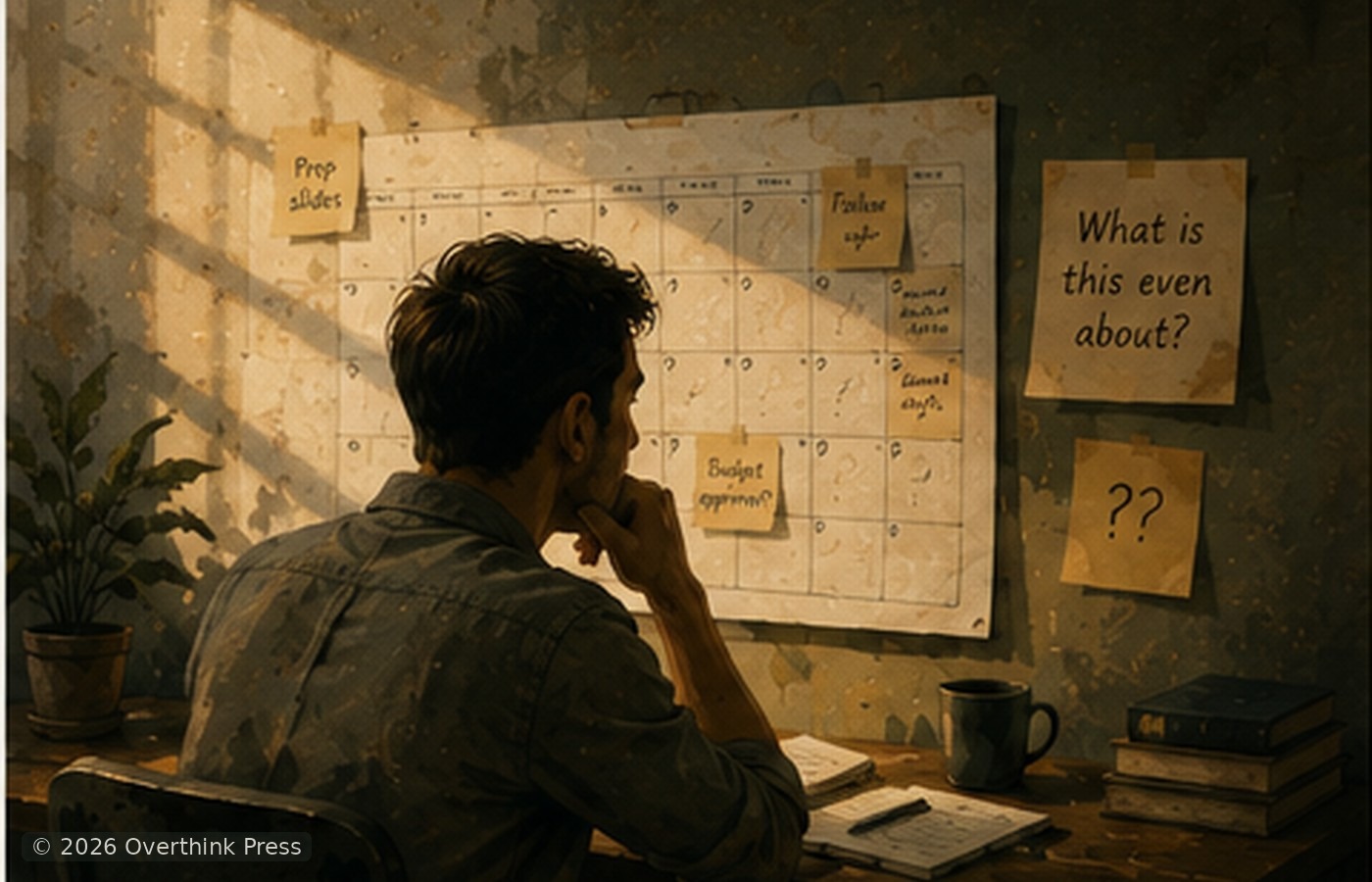
Just a small rectangle sitting on my calendar like it knew something I did not.
I stared at it.
A calendar invite with no agenda should be illegal in at least seven emotional jurisdictions.
My rational brain reviewed the available information.
It was a meeting.
Meetings happen at work.
The person who sent it regularly scheduled meetings.
There was no evidence of danger.
My anxious brain rejected this lazy analysis and opened a more comprehensive investigation.
Why Thursday?
Why thirty minutes?
Why “discussion” instead of “quick meeting”?
Was “quick” meant to sound casual?
Was it casual in the way people say, “Quick question,” before introducing a request that will permanently change your week?
I opened the invitation again.
Still no agenda.
I checked the attendee list.
Just the two of us.
This was not encouraging.
I looked at my recent work.
The project was on schedule.
The numbers were correct.
I had answered every email.
But anxiety is not interested in your general record. It wants one tiny inconsistency it can enlarge for the court.
I remembered a message I had sent the previous Friday.
Was the tone too short?
I reread it.
“Attached is the revised document. Please let me know if you need anything else.”
Terrifying. Practically a threat.
I remembered a meeting where I had disagreed with someone.
Had I sounded difficult?
I had said, “I think we should consider another option.”
Absolutely reckless behavior. Clearly, I had abandoned professionalism and entered my controversial era.
By lunchtime, I had built three possible explanations.
One: I was being removed from a project.
Two: there was a complaint.
Three: the company had discovered that I occasionally copied and pasted the same polite sentence into different emails and could no longer trust me.
I told myself to stop thinking about it.
This instruction had the same effect as telling a dog not to look at a sandwich.
For the rest of the day, the meeting remained open in the background of my mind.
While I worked, part of me prepared answers.
While I drove, part of me imagined the conversation.
While I tried to sleep, part of me created a detailed defense for mistakes no one had accused me of making.
The next morning, I decided I could not continue emotionally starring in a workplace thriller based on a blank calendar field.
I opened the invitation and typed:
“Happy to connect. Is there anything specific you would like me to prepare for our discussion?”
I read the message five times.
Was it too nervous?
Was it too formal?
Would asking for context create context?
Eventually, I sent it.
Seven minutes later, the response arrived.
“Nothing major. I’d like your thoughts on the new project timeline.”
That was it.
A timeline.
No complaint.
No surprise termination.
No confidential committee examining my punctuation.
My body relaxed, but not completely.
Because now another thought appeared:
What if “nothing major” was exactly what someone would say before something major?
Anxiety is extremely committed to remaining employed.
Thursday arrived.
I joined the call early because arriving on time felt emotionally risky.
The conversation was, in fact, about the project timeline.
They wanted my opinion because I had experience with similar work.
For several days, I had believed I was being summoned because I had done something wrong.
In reality, I had been invited because my judgment was valued.
When the meeting ended, I sat quietly for a moment.
I wanted to laugh.
I also wanted to feel frustrated with myself.
Why had I lost so much time to something that had never happened?
But blaming myself would have missed the point.
My mind was not trying to ruin my week.
It was trying to protect me from being surprised.
Somewhere along the way, uncertainty had started feeling dangerous. Missing information became a blank screen where fear could project anything it wanted.
Workplace anxiety loves missing context.
It can take an empty description box and turn it into a novel, a courtroom drama, a restructuring announcement, and a resignation speech before lunch.
The answer is not always to tell yourself, “Everything is fine.”
Sometimes everything is not fine.
The more useful practice is to separate what you know from what you fear.
What did I know?
I had received a meeting invitation.
What did I fear?
That the invitation represented a threat.
Those were not the same thing.
And when appropriate, asking for context is not weakness. It is not being needy. It is information hygiene.
“Is there anything you would like me to prepare?”
“Could you share the goal of the meeting?”
“Can you provide a little context?”
These are normal questions.
You are allowed to request information before your imagination submits a report with 40 pages.
Small prompt: Where am I filling in silence with fear instead of facts?