
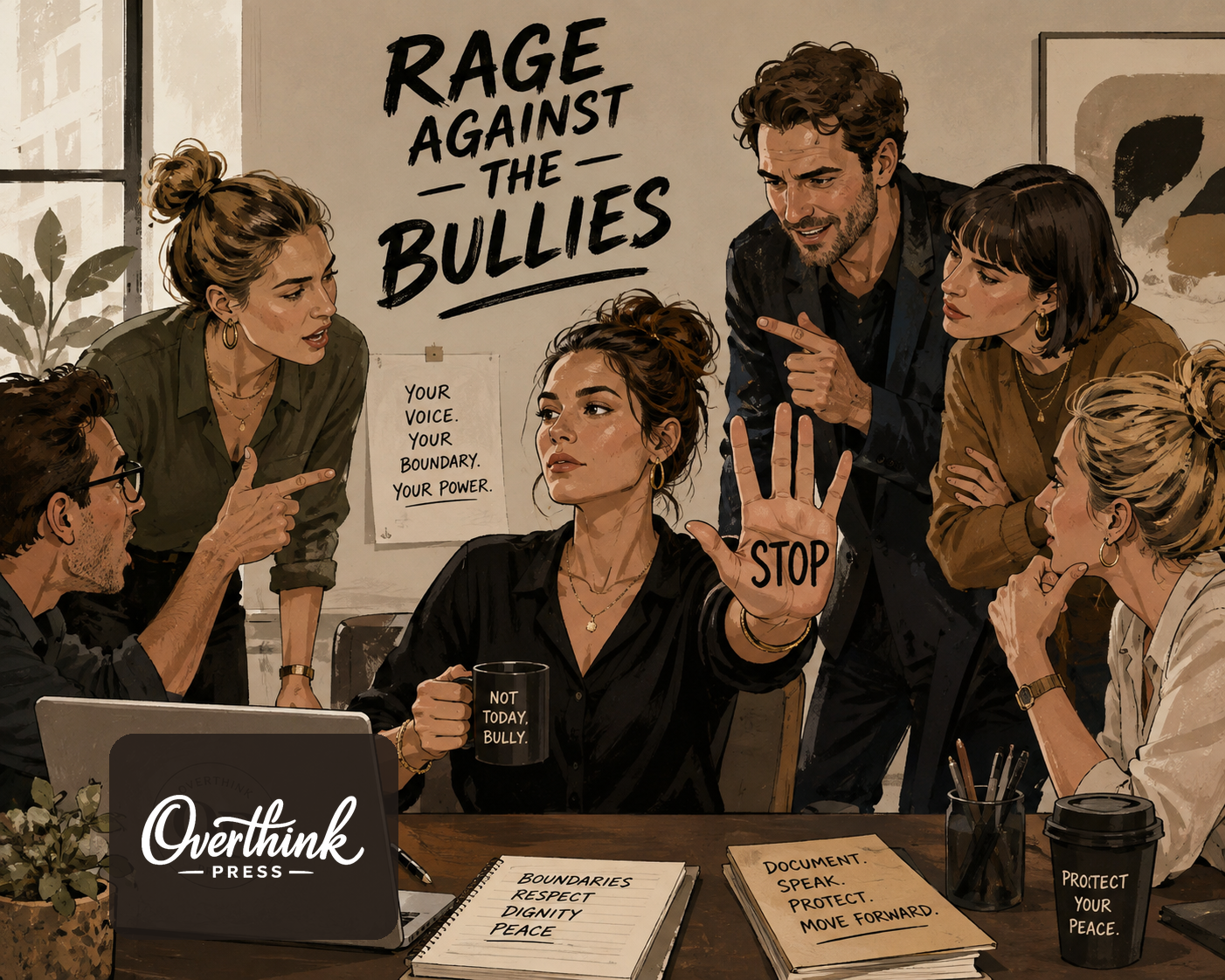
There is a special kind of anger that comes from watching a bully get comfortable.
Not just loud.
Comfortable.
Comfortable enough to make the same joke again.
Comfortable enough to embarrass someone in front of other people.
Comfortable enough to roll their eyes, interrupt, mock, exclude, dismiss, and then act confused when somebody finally looks upset.
And somehow the victim is expected to remain calm, professional, mature, reasonable, emotionally intelligent, and preferably silent.
Amazing.
The bully gets a personality.
The victim gets a breathing exercise.
Bullying did not graduate with us
When we were younger, bullying was easier to identify.
Someone shoved another kid.
Someone made fun of the quiet student.
Someone deliberately excluded somebody from a group.
Adults called it bullying.
Then we all grew up, got jobs, learned how to use Outlook, started wearing respectable shoes, and apparently decided bullying needed better branding.
Now it can sound like:
"We are just joking."
"That is just how she is."
"He has a strong personality."
"You need thicker skin."
"Do not take it personally."
"We are all friends here."
That last one can be especially interesting when the "friends" include the boss.
Because workplace bullying gets much harder to challenge when the people doing it are socially protected.
They eat lunch together.
They text each other.
They have inside jokes.
They know the boss outside of work.
They have worked together forever.
And suddenly one person is standing outside a little private kingdom wondering whether they are imagining the whole thing.
They are usually not.
I once watched someone disappear in a room full of people
Years ago, I watched a situation unfold during a meeting.
There was one person in the room who had become the group's unofficial target.
Nothing dramatic happened at first.
That is usually how these things work.
A comment here.
A sarcastic joke there.
A correction that could have been private but somehow needed an audience.
Every time this person spoke, someone interrupted.
Every time they suggested something, somebody smirked.
If someone else repeated the exact same idea ten minutes later, suddenly it was brilliant.
You could see the change happening in real time.
At the beginning of the meeting, they were participating.
By the middle, they were speaking less.
By the end, they were sitting with their hands folded, saying nothing.
The bullies probably went home thinking it had been a normal day.
The person they targeted probably replayed that meeting for hours.
That is one of the ugliest things about bullying.
One person experiences five minutes of entertainment.
Another person carries it home.
Silence does not always mean weakness
People often judge victims for not speaking up.
Why did you let them talk to you that way?
Why did you not say anything?
Why did you not defend yourself?
Because sometimes your brain does not immediately produce a heroic movie speech.
Sometimes it freezes.
Sometimes you are shocked.
Sometimes the bully has power over your paycheck.
Sometimes six people are laughing and you are the only one who is not.
Sometimes you are wondering whether speaking up will make things worse.
Sometimes you have spent so long trying to be reasonable that you no longer trust your own anger.
And sometimes you simply do not know what to say in the moment.
That does not make you weak.
But silence can become dangerous when it teaches the bully that there is no resistance.
So when will they stop?
This is usually the question.
When will the bully stop?
When will they grow up?
When will somebody notice?
When will management step in?
When will karma arrive with a clipboard?
Maybe.
But I think there is another question worth asking.
When do you want them to stop?
Because there is a point where waiting for someone else to discover the problem becomes its own kind of prison.
You may not feel confident.
You may hate confrontation.
You may be shaking inside.
You may immediately regret opening your mouth.
You can still say one word.
Stop.
Not a speech.
Not a TED Talk.
Not a perfectly structured statement approved by legal.
Stop.
Start with STOP
I am not suggesting you scream across the conference room and flip a table.
Although I understand the fantasy.
I mean something much simpler.
Someone makes another joke at your expense.
"Stop."
Someone interrupts you repeatedly.
"Stop. I was not finished."
Someone speaks to you disrespectfully.
"Stop. Do not speak to me like that."
Someone tries to embarrass you in front of other people.
"Stop. If you have feedback, say it directly and professionally."
Someone touches your belongings, mocks your work, copies others into unnecessary criticism, or repeatedly pushes a boundary.
Stop.
It may feel awkward.
Good.
Awkwardness is not always a sign that you did something wrong.
Sometimes awkwardness is what happens when someone realizes the person they have been pushing finally pushed back.
Anger is not always the enemy
We spend a lot of time being told to control our anger.
And yes, anger can absolutely become destructive.
But anger can also be information.
Anger can be your brain saying:
That was disrespectful.
That crossed a line.
I do not like how I am being treated.
This keeps happening.
Something needs to change.
You do not have to become aggressive.
You do not need to insult anyone.
You do not need to match the bully's behavior.
Use the energy.
Not the chaos.
Turn it into a boundary.
That is much more useful than pretending you are completely unbothered while mentally composing a resignation letter in the bathroom.
Confidence does not grow in a cornfield
People love saying things like:
"Find your confidence."
Wonderful.
Where?
Is there a confidence aisle at Target?
Can I order some with same day delivery?
Confidence is often treated like a magical object we are supposed to discover before we are allowed to defend ourselves.
I do not think it works that way.
Sometimes confidence comes after the action.
You speak while nervous.
You set the boundary while your heart is pounding.
You tell someone to stop even though your voice is not as steady as you would like.
Then you survive the moment.
And next time, the word comes out faster.
That is how confidence sometimes gets built.
Not in a cornfield.
In repetition.
The bully may not suddenly become enlightened
This part matters.
Saying "stop" does not guarantee the bully will apologize, reflect deeply, and begin a personal growth journey.
Some will laugh.
Some will deny it.
Some will say you are too sensitive.
Some will tell other people you are difficult.
Some may even escalate.
That is why a boundary should not always be your only move.
If the behavior continues, document it.
Write down dates.
Save messages.
Keep emails.
Record what happened while the details are still fresh.
Use formal reporting channels when appropriate.
If the boss is part of the problem, understand that the situation may require a different strategy than simply confronting the group.
Speaking up and protecting yourself are not opposites.
Sometimes the strongest response is a direct boundary.
Sometimes it is documentation.
Sometimes it is escalation.
Sometimes it is leaving an environment that has made cruelty part of its culture.
But none of those options require you to pretend the behavior is acceptable.
Bullies rely on the room
A bully rarely operates completely alone.
They rely on laughter.
Silence.
Social approval.
People looking away.
People saying, "I do not want to get involved."
People minimizing what happened because confronting it would be inconvenient.
That is why one person saying "stop" can change the temperature of a room.
Not always.
But sometimes.
And if you are not the victim, you still have a role.
You can say:
"That is not necessary."
"Let her finish."
"That was inappropriate."
"He already answered you."
"We do not need to make this personal."
Small sentences.
Big difference.
Bullies often become powerful because everyone else keeps waiting for someone more qualified to object.
You do have a voice
Maybe it is not loud yet.
Maybe it shakes.
Maybe you think of the perfect response three hours later while taking a shower.
Welcome to being human.
But you still have one.
You do not have to become the toughest person in the room.
You do not have to become fearless.
You do not have to transform into some fearless motivational speaker who walks into work every morning accompanied by dramatic music.
Start smaller.
Start with the boundary.
Start with the word.
Stop.
Because sometimes the first step toward ending bullying is not finding confidence.
It is deciding that your discomfort matters too.
And if someone has become very comfortable making you uncomfortable, perhaps it is time to return the favor.
Professionally, of course.