Parents are fascinating when it comes to careers. You can be eight years old, eating cereal, barely capable of remembering where you left your shoes, and somewhere in the house an adult has already decided: Doctor. Lawyer. Nurse. Banker. Politician. Engineer. Famous artist. Something respectable. Something stable. Something they can proudly explain when another parent asks: "So what does your daughter do?" Nobody dreams of answering: "She is still figuring it out." That apparently lacks prestige.
My mother wanted me to become a nurse
And I understand why. Nursing is respected. It is meaningful. It has a clear profession attached to it. You study nursing. You become a nurse. Beautiful. Very organized. Parents love careers with straightforward nouns. Doctor. Lawyer. Nurse. Architect. There is comfort in that. Try explaining experiential marketing to relatives. "So what exactly do you do?" "Well, I create global experiences around technology brands, products, customers, partners, sales, content, and business goals." Blank stare.
"So... advertising?" Sure. Let us go with that. My mother wanted nursing for me, and at the time I followed her direction. Not because someone chained me to a nursing textbook. I agreed. Partly because when you are young, your parents' certainty can feel more convincing than your own uncertainty. They seem to know things. They pay bills.
They understand taxes. They know which medicine to take when you have a fever. Surely they also know what career you should have for the next forty years. That seemed logical. Until practicum.
Then reality entered the chat
There are careers that sound perfectly reasonable from a classroom. Then you actually experience the work. That is when your personality gets a vote. During practicum, I started realizing something uncomfortable. I could respect nursing deeply and still not belong in nursing. Those are not contradictions. Nurses need qualities I absolutely admire. Patience. Care. A particular kind of emotional steadiness.
The ability to deal with situations that would probably have me standing in the hallway thinking: I am not equipped for this. I started noticing that I was not simply nervous because I was learning. Something deeper felt wrong. The work did not fit me. And there is an enormous difference between: "This is difficult." and "This is not my road." That distinction took me a while to admit.
Because by then, it was not just about school anymore. My mother wanted this. I had already started. People knew what I was studying. Changing direction felt less like selecting another course and more like making a public announcement that I had gotten my own life wrong.
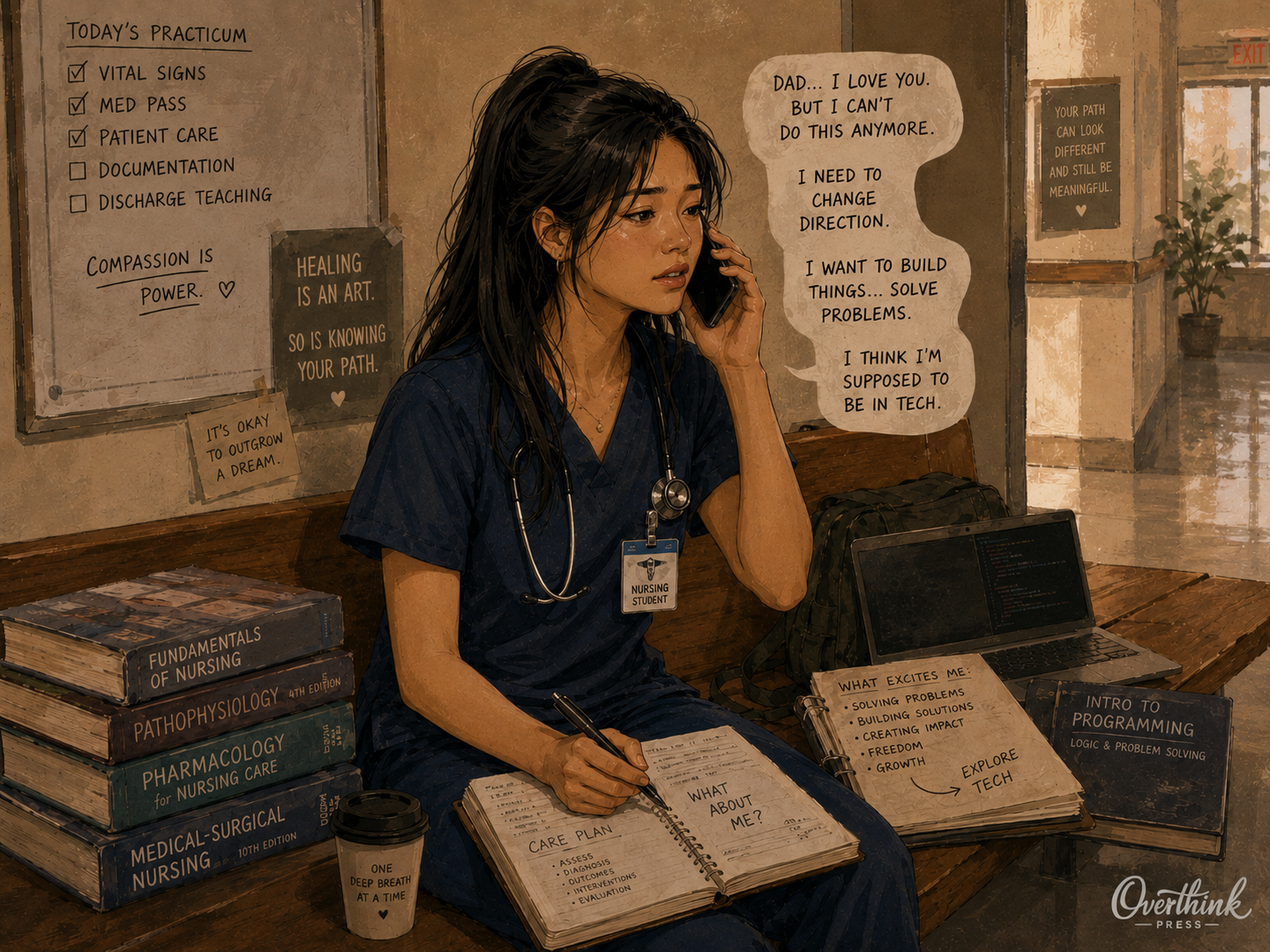
I called my dad
Eventually I reached the point where pretending became harder than admitting it. I called my father. I told him: "I cannot do this." Not in the dramatic sense. No orchestra. No rain outside the window. Just the uncomfortable truth. I did not want to become a nurse. I wanted to study information technology. That was what interested me.
Technology made sense to me in a way nursing did not. Systems. Problems. How things worked. How people used them. What technology could change. I wanted to understand that world. So I changed direction. And I graduated with a degree in information technology. Wonderful. Problem solved. Except, of course, life enjoys plot twists.
Then I barely worked like a traditional IT graduate
This is where career planning becomes funny. I studied information technology. Then my career kept moving toward marketing. Branding. Sales. Events. Exhibitions. Technology companies. Customer experiences. Helping people understand products. Building environments where companies could show what technology actually does. At first glance, you could argue: "Well, that is not really IT." True. I was not sitting somewhere writing software.
I was not building networks. I was not architecting systems. If you handed me complicated code, I would respectfully locate the person who actually knows what they are doing. But technology never disappeared from my career. It simply became the thing I translated. My job became helping people understand it. Why does this product matter? Who needs it?
How do you explain something technical without making people's eyes glaze over? How do you bring a technology brand into a room and make people curious enough to walk toward it? How do you turn features into something another human being actually cares about? Apparently my information technology degree and my marketing brain had been quietly negotiating behind my back.
And eventually they found a deal.
Maybe careers are not as literal as we think
When we are young, people often talk about careers like train tracks. Choose one. Stay on it. Arrive somewhere respectable. But careers can behave more like cities. You start on one street. Turn somewhere unexpected. Get lost. Find another road. Realize you like the neighborhood. Stay for nine years. Nobody explained that part during entrance exams. We are asked to choose what we want to study at an age when some of us still think thirty is ancient.
Then everyone acts surprised when our interests evolve. Of course they evolve. We evolve.
I do not think my mother was trying to control my life
This is important. Parents usually have reasons. Some grew up without financial security. Some know what unemployment looks like. Some experienced poverty. Some sacrificed enormously to give their children opportunities they never had. So when they say: "Become a doctor." Sometimes what they really mean is: "I want you to be safe." When they say: "Become a lawyer." Maybe they mean: "I want you to have options." When they say: "Go into finance." Maybe they mean: "I never want you to worry about money the way I did."
Love does not always arrive in perfect language. Sometimes it arrives disguised as career pressure. That does not make the pressure imaginary. It just makes it more complicated.
Because eventually you have to live the career
Your parents can recommend the profession. They cannot wake up and do it for you. They will not attend every class. They will not take every exam. They will not sit through every difficult meeting. They will not experience every Sunday evening before Monday morning. They will not carry the stress of work that does not suit you.
You will. That is probably the part we struggle to understand when we are younger. We are afraid of disappointing our parents now. But choosing the wrong life can disappoint us for decades. That is a very expensive way to avoid one uncomfortable conversation.
There is also no guarantee that your first choice is your final identity
Even choosing information technology did not lock me into one narrow future. That degree gave me a foundation. Then my personality took it somewhere else. I liked people. Communication. Storytelling. Selling ideas. Building experiences. Understanding what catches attention. Taking complicated things and making them understandable. So I ended up working around technology rather than becoming the person building it.
And somehow, years later, it makes perfect sense. My career has been about helping people discover technology. Helping brands explain it. Helping sales teams show it. Helping customers experience it. Helping new products enter rooms full of people who may not yet understand why they matter. That is still technology. Just through a different door.
Parents sometimes see careers as finished products
Maybe because adulthood looks more organized from the outside. You see the doctor. You do not see the eighteen year old who was not sure. You see the executive. You do not see the first job they hated. You see the successful artist. You do not see the years when relatives kept asking when they were getting a real job.
We love clean career stories after they work out. Before they work out, they look suspiciously like confusion. That is why changing direction can feel frightening. You do not yet know whether your decision will become a brilliant pivot or an embarrassing mistake. Neither do your parents. Everybody is guessing with different levels of confidence.
I am glad I tried nursing
Strangely enough, I do not think that part was wasted. It taught me something valuable. Sometimes you need to experience the wrong thing closely enough to recognize the right direction. If I had never tried it, maybe nursing would have stayed in my head as one of those imaginary alternate lives. Maybe I would have wondered: What if?
Instead, I know. I respect the profession. I respect the people who can do it. And I know I was not meant to be one of them. There is peace in knowing that.
Maybe disappointing someone briefly is sometimes necessary
That may be the hardest part. There are moments when choosing yourself will disappoint someone who loves you. Not because you are rejecting them. Not because you do not appreciate what they have done. Not because their opinion means nothing. But because eventually your life has to become yours. That does not require rebellion for the sake of rebellion.
You do not need to select a career purely because your parents hate it. That would still mean they are controlling the decision. Just from the opposite direction. The goal is not: "What would make my parents happy?" Or: "What would annoy my parents?" Maybe the better question is: "What kind of work can I realistically imagine myself becoming good at without slowly resenting everyone involved?" Not quite as inspirational as a graduation speech.
Much more useful.
My mother wanted a nurse
She got someone who works with technology, brands, events, marketing, people, products, and whatever problem happens to be sitting on the table. Not exactly the original plan. But I think that is how many lives turn out. Our parents sketch one version. We attempt parts of it. Life edits. We edit again. Eventually the picture starts looking like us.
And maybe that is what growing up actually is. Not rejecting everything our parents wanted. Not blindly following it either. Just slowly learning which parts of their hopes belong to us and which ones we need to hand back. I never became a nurse. I became an information technology graduate who spent her career helping people understand technology.
Apparently I did use the degree. I just refused to use it in the obvious way.