
There are certain sentences in the workplace that sound motivating until you are the person responsible for executing them.
"Make it happen."
"Figure it out."
"We need to move fast."
"Just get it done."
Wonderful.
Would you also like me to bend time?
Because sometimes the problem is not effort.
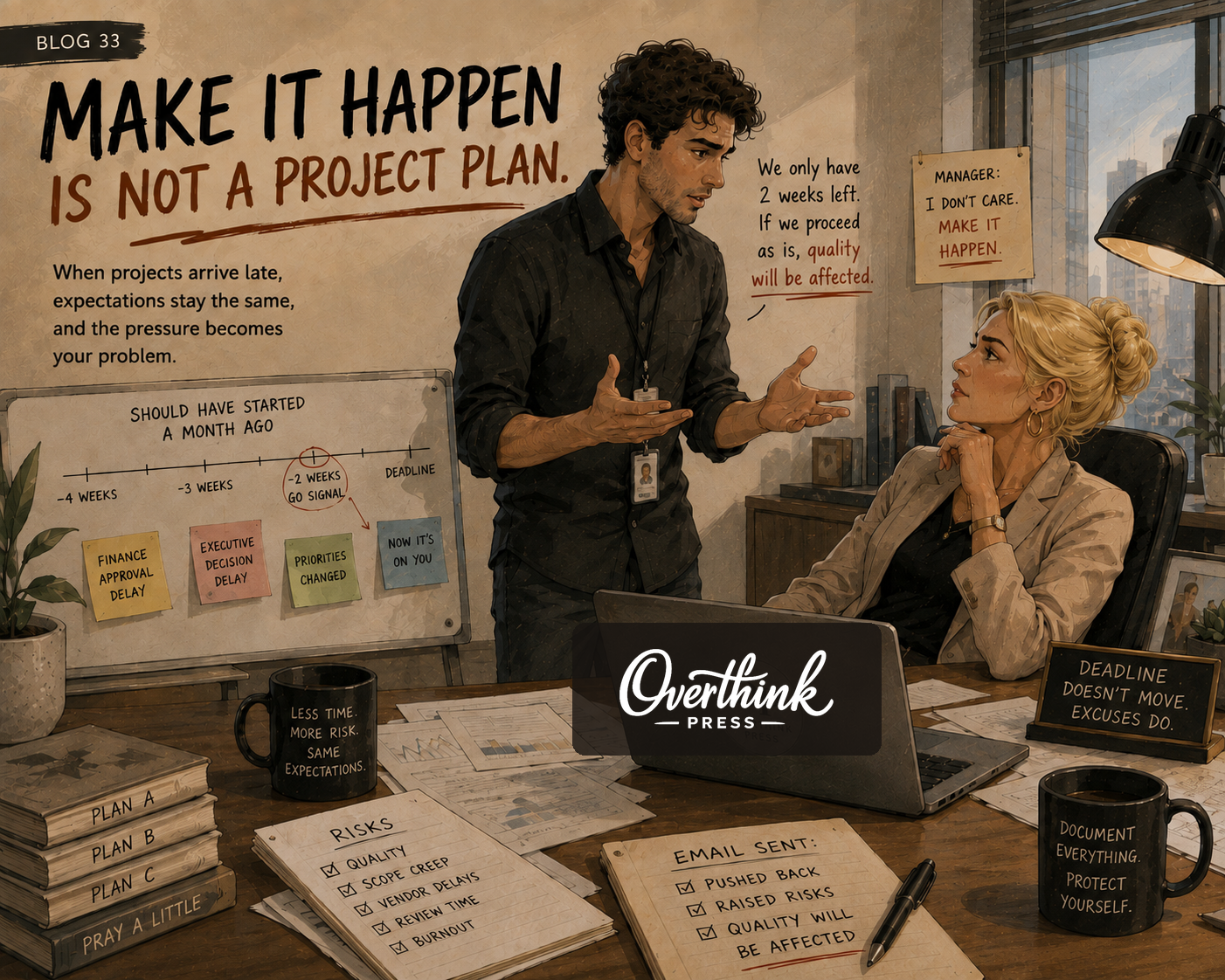
The problem is that a project that should have started a month ago arrives on your desk with two weeks left, almost no information, no groundwork, and somehow the original expectations are still sitting there like nothing happened.
This happens in almost every office.
Finance approval took longer than expected.
An executive decision sat somewhere for two weeks.
Leadership changed direction.
Someone forgot to assign an owner.
A contract was delayed.
A budget was not approved.
The project bounced around between departments until somebody finally realized:
"Oh right. We need to execute this."
Then it lands on someone's desk.
Congratulations.
You now own the consequences of everyone else's lost time.
I once received a project that was already late before I touched it
The project should have started about a month earlier.
Instead, my manager handed it to me with roughly two weeks remaining.
There was no beautiful transition document.
No carefully prepared project brief.
No neat folder containing everything I needed.
We were basically starting from scratch.
So I did what I thought was responsible.
I went to my manager's desk.
I explained the timeline.
I explained the work required.
I explained the risks.
If we moved forward with only two weeks, something would have to give.
Scope.
Quality.
Cost.
Testing.
Review time.
Vendor options.
Some combination of all of them.
I was not refusing the project.
I was saying:
"This can be done, but we need to understand what we are accepting by doing it this way."
His response was essentially:
"I do not care. Make it happen."
Ah.
The ancient managerial methodology.
Make.
It.
Happen.
Very sophisticated.
Probably taught at business school somewhere between finance and organizational behavior.
So I went back to my desk and wrote an email
Not an angry email.
Not a dramatic email.
Not:
"Dear Sir, as per our extremely irritating conversation..."
Although spiritually, perhaps.
I documented what we had discussed.
I wrote that I had raised concerns about the compressed timeline.
I explained that I would proceed as directed.
And I noted that because we had significantly less preparation time than originally required, quality could be affected.
Why did I write it?
Because I genuinely did not know what the final project was going to look like.
And if something went wrong two weeks later, I did not want everyone suddenly developing selective memory.
You know selective memory.
The corporate condition where everybody forgets the conversation except the person who was warned something would happen.
Then the next two weeks became war chess
Every morning I woke up thinking about the project.
What if the vendor cannot deliver?
What if something needs to be reprinted?
What if we discover a mistake three days before launch?
What if an executive changes something?
What if somebody asks why this was not done sooner?
What if.
What if.
What if.
The project stopped being a project.
It became a strategy board in my head.
Move this here.
Call them now.
Push that forward.
Delay this.
Approve that.
Prepare a backup.
Prepare a backup for the backup.
Find another supplier.
Check everything again.
And while everyone else could say, "It will work out," the person responsible for execution does not always get that luxury.
Because "it will work out" usually means somebody will work very hard to make sure it does.
The deadline did not become shorter
The preparation time did.
This distinction matters.
If a project normally requires four weeks and leadership gives you two, the work did not magically shrink by fifty percent.
The calendar did.
There is still planning.
There are still approvals.
There are still vendors.
There are still reviews.
There are still dependencies.
There are still mistakes that need time to be discovered and corrected.
A month of work squeezed into two weeks does not automatically become two weeks of work.
It becomes four weeks of work performed with less sleep.
And usually more coffee.
But managers will say this is our job
And sometimes they are right.
Partially.
There are jobs where dealing with difficult timelines is absolutely part of the role.
Projects change.
Emergencies happen.
Executives move priorities.
Clients change their minds.
Budgets are approved late.
Sometimes everyone genuinely has to move faster.
That is business.
The problem begins when "things happen" becomes an excuse for poor planning.
There is a difference between:
"We had an unexpected situation, and we need everyone's help."
and
"We lost two weeks, but you are still responsible for pretending we did not."
One is teamwork.
The other is transferring risk downward.
So do employees actually have a say?
Yes.
Having a say does not always mean having the final decision.
That is an important distinction.
Your manager may still tell you to proceed.
Leadership may still accept the risk.
The deadline may remain exactly where it is.
But you can still say:
"Here is what is realistic."
"Here is what we can achieve."
"Here is what will need to change."
"Here are the risks."
"Here is what I recommend."
And if leadership chooses to proceed anyway, document the decision.
Not because you are trying to play office detective.
Because project management requires clarity.
If quality may suffer, say it.
If cost may increase, say it.
If you need additional resources, ask.
If a requested deadline creates genuine risk, explain why.
That is not insubordination.
That is doing your job.
Pushback is not refusing to work
Some workplaces treat any form of disagreement as negativity.
That is dangerous.
There is a massive difference between:
"I do not want to do this."
and
"I can do this, but these are the consequences of the current timeline."
One is refusal.
The other is professional judgment.
If you hire people because they have experience, you have to allow them to occasionally tell you something you do not want to hear.
Otherwise you did not hire expertise.
You hired obedience with a laptop.
The paper trail matters
I know email documentation can feel defensive.
Sometimes it is.
But there is a professional way to do it.
After a difficult conversation, summarize the agreement.
"Following our discussion, we will proceed with the two week timeline."
Then state the known risks.
"Because the project is beginning later than originally planned, we may have limited review time and fewer options if changes are required."
Then state your plan.
"I will prioritize the critical deliverables and provide updates as we move forward."
Done.
No accusations.
No emotional warfare.
No seventeen paragraph manifesto.
You have documented reality.
Because if everything succeeds, wonderful.
And if something fails, everyone can look back and understand the conditions under which the project was executed.
But the stress is real
This is the part people sometimes underestimate.
Compressed projects do not only affect the project.
They affect the people.
You go home but your brain stays at work.
You are eating dinner while calculating timelines.
You wake up remembering something you forgot to check.
You are taking a shower and suddenly solving a vendor problem.
Your partner asks what you are thinking about.
You say:
"Nothing."
Meanwhile your brain is running twelve contingency plans.
For someone already prone to anxiety, this kind of environment can turn regular work stress into something much heavier.
The constant uncertainty.
The responsibility.
The feeling that something might go wrong.
The fear that if it does, the timeline will somehow be forgotten and the outcome will become your fault.
Your nervous system does not care that the problem originated three departments away.
It only knows you are now responsible for fixing it.
Managers should care about how the work becomes possible
"Make it happen" is sometimes necessary.
But good leadership should eventually follow that sentence with:
"What do you need?"
Do you need another person?
More budget?
A faster approval process?
Reduced scope?
A decision today instead of Friday?
Help removing a blocker?
Because urgency without support is not leadership.
It is delegation with adrenaline.
If something truly has to happen in two weeks, fine.
Then let's talk about what two weeks actually allows.
Maybe we reduce the scope.
Maybe we accept a simpler version.
Maybe leadership approves additional cost.
Maybe certain features wait until phase two.
Maybe everybody agrees that perfect is no longer the goal.
That is an actual decision.
Simply saying "make it happen" and expecting the original scope, quality, cost, and timeline to remain untouched is not a decision.
It is wishful thinking wearing a badge.
The person executing should not absorb all the consequences
This may be the part we need to say more often.
If a project begins late because of delayed leadership approval, finance approval, changing priorities, or decisions outside the project owner's control, that context should remain visible.
Do not hand someone a delayed project and then evaluate them as though they had the original timeline.
Do not create an emergency and then criticize the person running because they look stressed.
And please do not ask:
"Why wasn't this planned earlier?"
We tried.
Remember?
There was an email.
Sometimes the project still succeeds
Mine did.
Not because two weeks was suddenly enough.
Not because the risks disappeared.
Not because "make it happen" activated some magical professional superpower.
It happened because those two weeks became extremely deliberate.
Every decision mattered.
Every backup mattered.
Every hour mattered.
It worked because someone absorbed the missing time through effort, planning, stress, and constant adjustment.
And that is exactly why successful last minute projects can become dangerous.
Everyone looks at the result and says:
"See? We knew you could do it."
No.
That is not the lesson.
The lesson is that people can sometimes rescue bad timelines.
It does not mean bad timelines are good management.
So yes, you have a voice
You may not control when a project lands on your desk.
You may not control the deadline.
You may not even win the argument.
But you can state what is realistic.
You can explain the risks.
You can recommend alternatives.
You can document the direction you were given.
And you can stop interpreting professional pushback as some kind of personal failure.
Sometimes saying:
"I will make this happen, but I need you to understand what making it happen will cost"
is exactly what a responsible employee should say.
Because employees are not time machines.
We cannot recover the month that disappeared before the project reached us.
We can only work with the time that remains.
So yes.
I will make it happen.
But please do not confuse the fact that I saved the project with proof that this was a reasonable way to run it.
Those are two very different things.