
As told to Overthink Press. Name and identifying details have been changed.
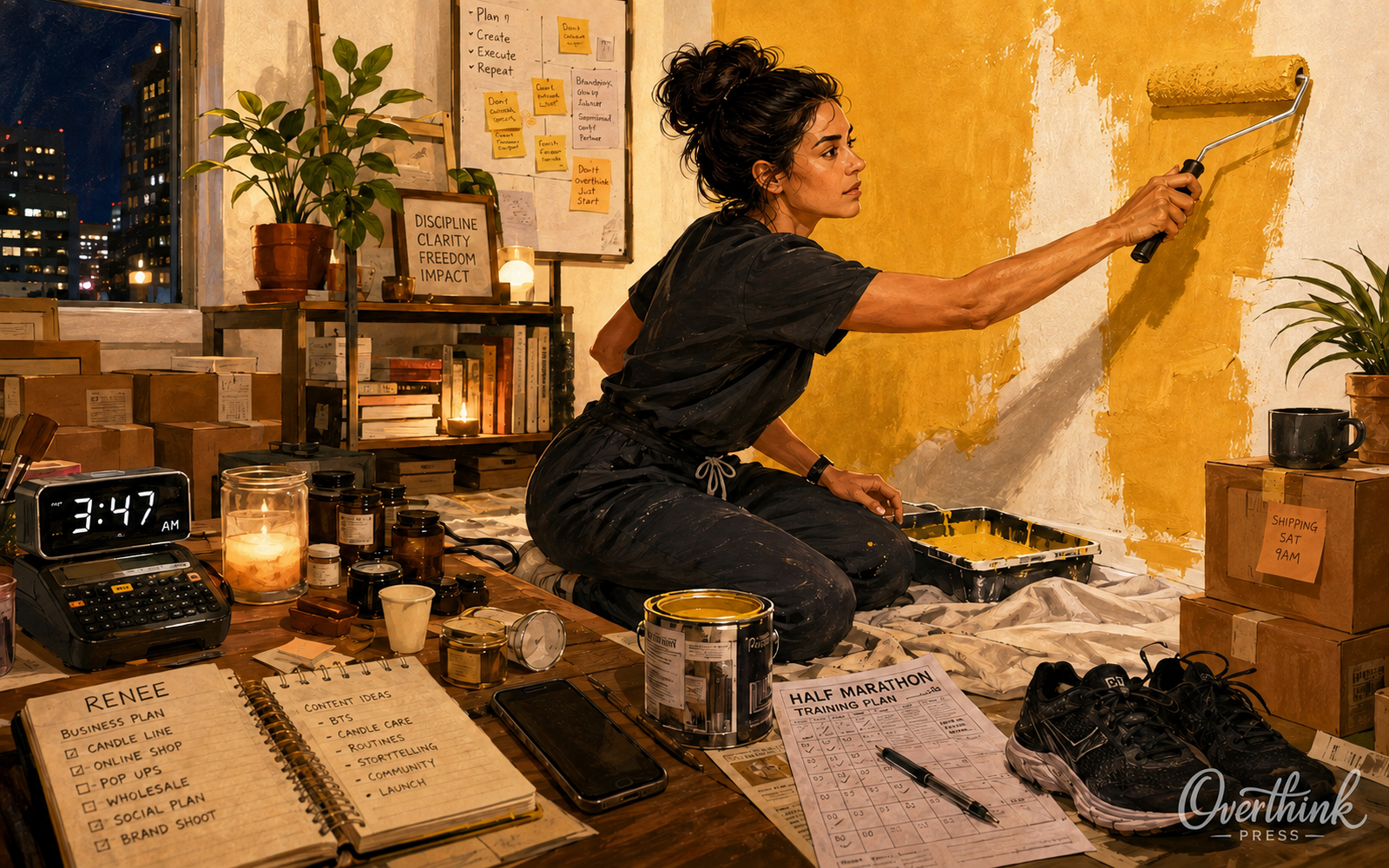
At 3:47 a.m., Renee was standing in her kitchen in old scrubs, rolling a fresh coat of paint she'd already started calling "Sunflower Clarity" onto a wall that, six hours earlier, had been beige and completely fine. She'd bought the paint at an all night hardware store after her shift, along with drop cloths, three new brushes, and a label maker she was already planning four other uses for. She felt incredible. Not tired incredible, not caffeine incredible — clear was the word she used later, describing it. Like her whole life had finally come into focus, and the focus was: everything, all at once, immediately.
This wasn't new, exactly. Renee had always been the friend who signed up for the half marathon on a whim, decided at lunch she should learn pottery, and came home from a twelve hour shift with enough energy to reorganize a closet that had not complained. People called her driven. Her family called her a lot. Renee called it finally getting things done.
For almost two weeks, sleep felt optional. Two hours was enough. Sometimes three if she was being responsible. She would wake before the alarm with a full list already running: recertification, paint kitchen, order candle supplies, design labels, compare business names, research a half marathon training plan, answer emails, maybe move the sofa because the room had bad energy from the current angle.
The candle business appeared on day four. By day six it had a name, a logo concept, three scent families, a spreadsheet of suppliers, and an imagined holiday collection. Renee had never made a candle. This did not feel like an obstacle. It felt like a detail that less motivated people might choose to worry about.
At work she was faster, louder, funnier, and certain. She volunteered for things before the sentence asking for volunteers was finished. She corrected a process nobody had asked her to review. She told a coworker she had figured out what she wanted to do with the next five years and then described seven different futures, all of them urgent.
Her friend Maya noticed the speed first. Renee's texts arrived in clusters of twelve. One idea would turn into four, and every fourth idea became a plan. When Maya wrote, "Are you sleeping?" Renee sent back a photo of a coffee, a paint roller, and a notebook titled PLANS with a heart drawn under it. She thought this was a reassuring answer.
It wasn't that Renee felt out of control. That was the confusing part. She felt more in control than she ever had. Every doubt she'd carried about money, work, her future, whether she was wasting her life — gone. The usual friction between an idea and doing the idea had disappeared. She had become, in her own mind, the version of herself everyone had been waiting for.
She spent more than she meant to. Not ruinous money, but enough that her banking app began sending notifications with the exhausted tone of a friend trying not to judge. Supplies. Registration fees. New running shoes. A domain name. A label printer. A second label printer because the first one suddenly seemed too limited for the brand she was building at 2:11 a.m.
Nobody staged an intervention. There was no dramatic scene. Mostly there were small moments that only looked important later: Renee talking so fast her sister stopped trying to interrupt; Renee laughing when a coworker told her to slow down; Renee driving across town for one specific notebook because the wrong notebook would apparently compromise the entire plan; Renee feeling irritated by people who could not keep up with how obvious everything had become.
Then, almost as quickly as it arrived, the clarity left.
The first morning of the crash, her alarm went off and Renee stared at it for nearly twenty minutes. Not snoozing. Not negotiating. Just staring. The phone was on the nightstand, close enough to touch, and somehow felt like an object across a parking lot.
The wall was yellow now. Very yellow. In daylight, Sunflower Clarity looked less like a revelation and more like a mustard related decision made by someone who owned three drop cloths and no brakes.
She called out of work. Then she cried because she'd called out of work. Then she stopped crying because even crying seemed to require a level of participation she no longer had.
The packages kept arriving. Candle jars. Wicks. Labels. Running gear. A box of business cards she did not remember ordering, printed with a company name that had felt brilliant four days earlier and now looked like something invented by a stranger. Each delivery was a small archaeological discovery from a civilization that had recently collapsed.
For the next week, Renee moved as if gravity had been personally adjusted. Showering required a plan. Answering a text felt rude to ask of herself. The half marathon registration sat in her inbox beside a reminder about recertification and an order confirmation for two hundred candle lids. Her life was full of evidence that she had recently believed she could do everything. She could barely decide what to eat.
Maya came over with takeout and did not comment on the wall. This was friendship at an advanced level.
Renee tried to explain it as burnout. Maybe she'd overdone it. Maybe the shifts had caught up with her. Maybe she just needed sleep. But this was not the first time the pattern had happened. It was only the first time the contrast had become impossible to dismiss.
Looking back, there had been other stretches: a week when she slept three hours a night and reorganized her entire financial life; another when she decided to go back to school, researched six programs, applied to two, and then could not open the acceptance email for days. They had never looked dramatic enough to her to deserve a name. They looked like ambition followed by failure. Productivity followed by laziness. A good version of Renee followed by a bad one.
That interpretation had been quietly destroying her confidence for years.
She finally told a doctor the whole pattern instead of only describing the part she was currently in. Not just the low week. The high one too. The sleeping less without feeling tired. The speed. The certainty. The spending. The projects. The feeling that every idea was not merely good but urgent and unusually important.
The evaluation did not happen in one cinematic appointment. There were questions, history, follow ups, uncomfortable specificity, and the strange experience of hearing ordinary memories rearranged into a pattern. Eventually, Renee was diagnosed with bipolar I disorder.
She says the diagnosis was both heavier and less dramatic than she expected. Heavy because bipolar was a word she had only ever encountered in other people's stories, usually when something had gone spectacularly wrong. Less dramatic because the clinician did not react like a plot twist had entered the room. They talked about episodes, sleep, treatment, warning signs, medication, routines, and what Renee's particular pattern looked like.
The hardest part was accepting that some of her favorite versions of herself needed boundaries too. She missed the energy. She missed the absolute confidence. She missed being able to start a project at midnight and feel like the universe had personally approved the business plan.
But she did not miss what came after.
Treatment was not a personality transplant. Renee is still the person who gets ideas in the shower and buys notebooks with unnecessary confidence. She still works hard. She still has ambitious weeks. The difference is that she watches sleep like it matters now. Maya is allowed to ask how many hours she has slept without being accused of trying to suppress innovation. Big purchases wait. New businesses survive at least one night's sleep before receiving a domain name.
She also learned that stability can feel boring when your brain has previously offered fireworks. Boring, it turns out, has advantages. You can make plans inside it. You can keep appointments inside it. You can wake up on a Tuesday and recognize the person who made Monday's decisions.
The kitchen wall is still yellow.
Renee considered repainting it beige, then decided that would give the wall too much symbolic authority. So she left it. She no longer calls it Sunflower Clarity. She calls it yellow.
For her, that is progress.
A note before you go
Bipolar disorder is a medical condition, not a personality type or a synonym for ordinary mood changes. If this story feels familiar, consider talking with a qualified mental health professional. If you are in immediate crisis in the US, call or text 988 for the Suicide & Crisis Lifeline.